


Table of Contents
- Murder Mystery Party Planning Essentials
- Choosing Your Theme and Selecting a Kit vs. DIY
- Murder Mystery Party Character Assignments and Roles
- Creating Murder Mystery Party Scripts and Dialogue
- Building Your Murder Mystery Party Timeline
- Murder Mystery Party Planning Tools and Resources
- Setting the Scene: Decor, Menu, and Atmosphere
- Hosting and Facilitating the Event
- Frequently Asked Questions
Last Updated: September 17, 2026
Murder Mystery Party Planning Essentials
Murder mystery party planning transforms a regular dinner into an immersive theatrical experience where guests become suspects, detectives, and witnesses. The key is balancing structure with spontaneity, enough scaffolding to keep the story moving, but enough flexibility for guests to genuinely enjoy themselves.
A well-executed murder mystery party planning event keeps guests engaged from arrival through the final accusation. The core challenge is clarity: guests need to understand their roles, know what clues matter, and feel their participation shapes the outcome.
Choosing Your Theme and Selecting a Kit vs. DIY
Your theme anchors everything that follows. A 1920s speakeasy mystery plays completely differently from a gothic mansion whodunit or a cozy bookshop setting. The theme determines decor, dialogue style, costume expectations, and even the pacing of reveals.
Pre-written kits for structured gameplay
Pre-written murder mystery party kits come with scripts, character descriptions, clue cards, and host guidance. The advantage is control and speed, every clue serves the narrative, the reveal happens on schedule, and you're not inventing backstories. The trade-off is personalization: a pre-written script limits how much guests can deviate from their roles.
DIY approach for custom control
DIY gives you complete creative control over setting, crime, suspects, and clue reveals. It requires more prep time, you're writing character descriptions, creating clue cards, and testing pacing. Logic errors or timeline gaps become obvious only during the event.
The sweet spot for many hosts is a hybrid: use a pre-written framework but customize character names, locations, or specific clues to match your guest list and setting. This gives you structure without sacrificing personality.
Murder Mystery Party Character Assignments and Roles
Every guest needs a character role. The best assignments match personality types to roles, confident guests as lead suspects, quieter guests as witnesses or secondary characters. Assign roles at least two weeks before the event, sending each guest their character description, backstory, and any dialogue or quirks.
Size your character count to your guest list. A six-person mystery might have three suspects and three investigators. Avoid assigning more characters than guests, every role should feel meaningful.
Consider power dynamics when assigning roles. With close friends, comedic or embarrassing roles work. With mixed groups, err toward flattering or neutral roles.
One guest should serve as co-host or facilitator. This person helps you manage timing, keeps the action moving, and can gently redirect guests who go off-script. The co-host role works well for someone naturally outgoing or experienced with group facilitation.
Creating Murder Mystery Party Scripts and Dialogue
Start with the crime: what happened, who benefits, what's the solution? Work backward, planting clues that point toward truth while creating false leads. Dialogue doesn't need to be elaborate, provide key talking points about how your character reacts to the murder, their whereabouts, and secrets they're hiding.
Build conflict between characters, if the banker and artist have history, their interactions become naturally tense. A few signature phrases or quirks per character make roles memorable without being overwhelming.
Building Your Murder Mystery Party Timeline
Your murder mystery party timeline is the backbone of the entire event. It sequences introductions, clue reveals, accusation rounds, and the final reveal. A timeline that's too loose loses momentum. One that's too rigid feels artificial.
Pre-party logistics and invitations
Send invitations three to four weeks before the event with theme, character name, costume suggestions, and whether dialogue memorization is expected. Confirm RSVPs two weeks out and have a backup character ready if someone cancels. Two days before, send a reminder with arrival time, parking, and costume notes.
Event-day schedule and pacing
Guests typically arrive 15 minutes early. Use this time for costume adjustments and settling in. Dim the lights, play atmospheric music, and have a signature cocktail ready.
Structure the event in acts. A typical three-act structure works like this:
Act One (30-40 minutes): Guests arrive in character. The host sets the scene and introduces the crime. Guests mingle and ask each other questions as the mystery unfolds naturally through conversation.
Act Two (45-60 minutes): The investigation deepens. Clues are revealed through the host or discovered by guests. Accusations fly and tension builds as guests work to solve the mystery.
Act Three (30-45 minutes): Guests vote on the culprit or the host reveals the solution. Include a twist if possible. Finish with a toast that honors the collaborative storytelling.
Total event time is typically two to three hours. Longer events lose energy; shorter ones feel rushed.
Murder Mystery Party Planning Tools and Resources
GreyDoor Goods offers Osti for One Party, an AI party-planning companion that creates your murder mystery party planning timeline, manages invitations, tracks RSVPs, and reminds you what needs to happen next. Osti handles logistics so you can focus on the creative and social aspects of hosting.

For those planning multiple events, Osti: Three Months or Osti: One Year keep your planning organized across multiple parties. Osti remembers details, generates guest-message drafts, and helps you avoid the typical host stress of juggling timelines and RSVPs.
Beyond digital tools, you'll need physical resources: character cards, clue envelopes, a printed timeline for yourself, and perhaps props or costume elements. Many hosts create a simple one-page character sheet for each guest that includes their role, backstory, and a few key talking points.
Setting the Scene: Decor, Menu, and Atmosphere
The environment shapes how immersed guests feel in the mystery. A carefully decorated space signals that this isn't a regular dinner, it's a theatrical event.
Thematic decorations and table settings
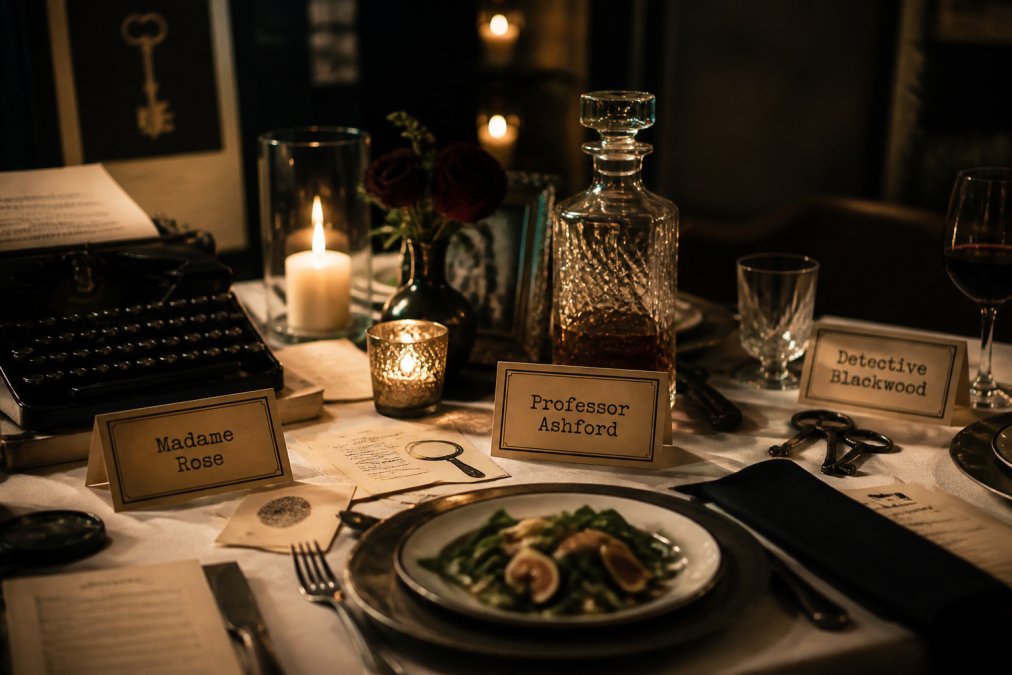
Dim the main lights and use candles, string lights, or colored bulbs to create atmosphere. Use place cards with character names and add small props that hint at the mystery: a fake poison bottle, a torn love letter, a mysterious photograph. A few well-chosen elements create atmosphere without requiring hours of setup.
Food, drinks, and service timing
Serve simple courses that don't require constant kitchen attention. A first course ready on arrival, a main that can sit briefly, and dessert after the reveal works well. Have thematic drinks ready and non-alcoholic options available. Avoid complex food that pulls you away during critical moments.
Hosting and Facilitating the Event
Your job as host is to guide without controlling. You set the scene, introduce the crime, reveal clues on schedule, and gently redirect if the mystery stalls. You're not performing, you're orchestrating.
Your role as game master and co-host
Start with a clear, atmospheric introduction. Set the scene and give guests their mission: figure out who did it. Then step back and let them investigate. A co-host is invaluable for managing the room, keeping conversations flowing, and steering people toward missed clues.
Check in periodically. If the mystery stalls, introduce a new clue or prompt an accusation. If energy is high, give guests space to work.
Managing the reveal and accusation phase
Guide guests toward the accusation phase. Some hosts ask guests to vote; others have the guilty party reveal themselves. The reveal should include motive, means, and opportunity so guests understand why the mystery unfolded as it did.
Finish with celebration. Toast the guilty party, thank everyone for participating, and perhaps ask guests what they enjoyed most. This closure signals the end of the theatrical experience and transitions back to regular socializing.
Troubleshooting common party failures
The mystery stalls. Introduce a new clue unprompted or have a character make a dramatic accusation.
A guest feels uncomfortable. Quietly reassign them to a different character or adjust their role.
The timeline falls apart. Let conversations run longer. You can compress later acts or skip non-essential clues.
Someone solves it too early. Confirm they're right and pivot to a shorter reveal, or introduce new information that complicates their theory.
Guests don't stay in character. This is fine.
Frequently Asked Questions
What do I do at a murder mystery party?
At a murder mystery party, you assume a character role and interact with other guests to uncover clues, develop alibis, and solve the crime. Throughout the event, you'll participate in roleplay, gather evidence, listen to accusations, and work toward identifying the suspect before the reveal. Your actions, dialogue, and interactions with other characters drive the narrative forward and create the immersive experience.
How many people are ideal for a murder mystery party?
Most murder mystery party scripts work best with 6 to 12 guests, though this varies by kit or design. Smaller groups (4-6 people) work if you double up on character roles; larger groups (12+) benefit from subplots and multiple suspects. Check your specific script or kit for recommended guest counts, as character assignments depend on the number of participants to maintain balance and engagement throughout the event.
How do I create a murder mystery party timeline?
Build your timeline backward from the party date. Start with invitations 3-4 weeks ahead, assign roles 2 weeks before, send character backgrounds 1 week prior, and handle final prep (decor, food setup) the day before. On party day, schedule the arrival, icebreaker activity, first clue reveal, dinner service, accusation phase, and final reveal. Tools like Osti can generate a personalized timeline and remind you of each step, removing guesswork from your planning.
What are common mistakes to avoid when hosting a murder mystery party?
Avoid over-complicating the plot, which confuses guests and slows pacing. Don't assign characters too close to the party date; guests need time to prepare. Skip lengthy monologues that bore attendees, keep dialogue punchy and interactive. Don't neglect accessibility needs or make assumptions about comfort levels with roleplay intensity. Finally, don't forget to brief co-hosts on their roles and the reveal timing, or the event may unravel during the accusation phase.